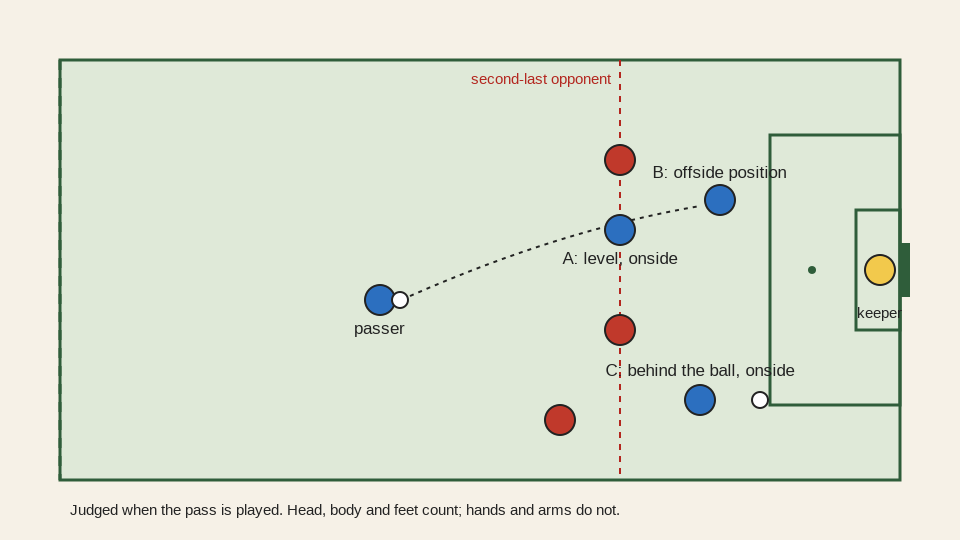
Offside position diagram drawn for One Life One Team; free to reuse with a link to this page
The Offside Rule Explained, from Law 11 Itself
Offside is the rule that confuses newcomers most and that causes the most arguments among people who understand it. It has also shaped how football is played more than any other law, deciding how high defences stand and how attackers time their runs.
Here is what Law 11 of the IFAB's Laws of the Game actually says, read from the law itself: the position, the three questions the assistant referee asks, the exceptions, why the rule exists and how it changed, and how VAR polices it. The diagrams use the law's own wording, simplified.
What Law 11 actually says
A player is in an offside position if any part of the head, body or feet is in the opponents' half (the halfway line does not count) and nearer to the opponents' goal line than both the ball and the second-last opponent. The goalkeeper is usually one of those two opponents, so in practice the line is the last outfield defender. Hands and arms are ignored for every player, goalkeepers included; the arm ends at the bottom of the armpit.
A player level with the second-last opponent, or with the last two opponents, is not in an offside position, and nobody can be offside in their own half. In the diagram above, attacker A is level with the defender and onside; B is beyond both the defender and the ball and in an offside position; C is beyond the defender but behind the ball, so onside. All three are judged at the moment the pass is played, not when the ball arrives.
Position is not an offence: the three questions
The law's first sentence is the one most arguments forget: it is not an offence to be in an offside position. A player in that position when a team-mate plays or touches the ball is penalised only on becoming involved in active play, in one of three ways: interfering with play by playing or touching a ball passed by a team-mate; interfering with an opponent by blocking their line of vision, challenging them for the ball, or making an obvious action that clearly affects their ability to play it; or gaining an advantage by playing a ball that has rebounded off the post, the bar, a match official or an opponent, or been deliberately saved.
A fourth question hides inside the third. If an opponent deliberately plays the ball to the attacker, with control and the chance to pass, keep or clear it, there is no offence even if the clearance was bad. A save is different: stopping a ball heading for the goal keeps the offside alive. The punishment is an indirect free kick from where the offence occurred, even in the offender's own half.
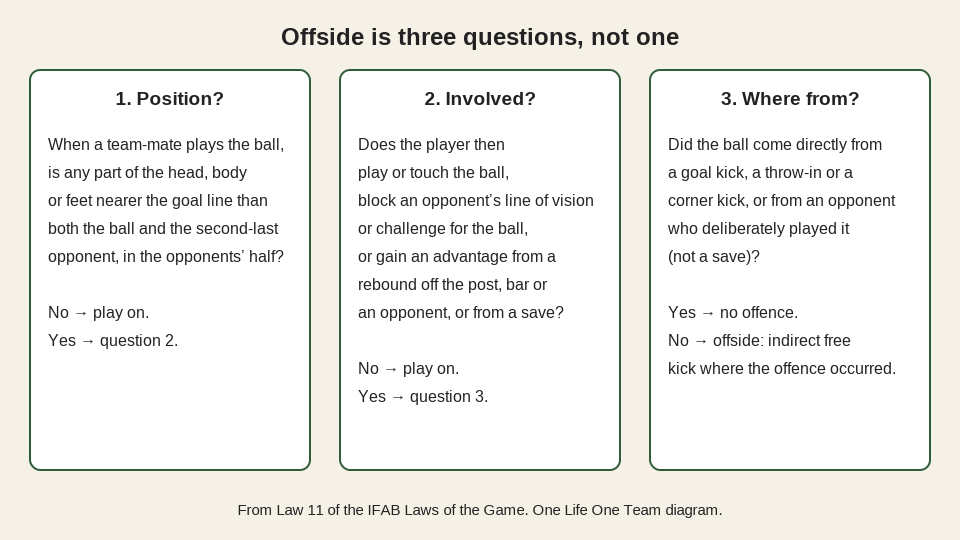
No offside from a goal kick, throw-in or corner
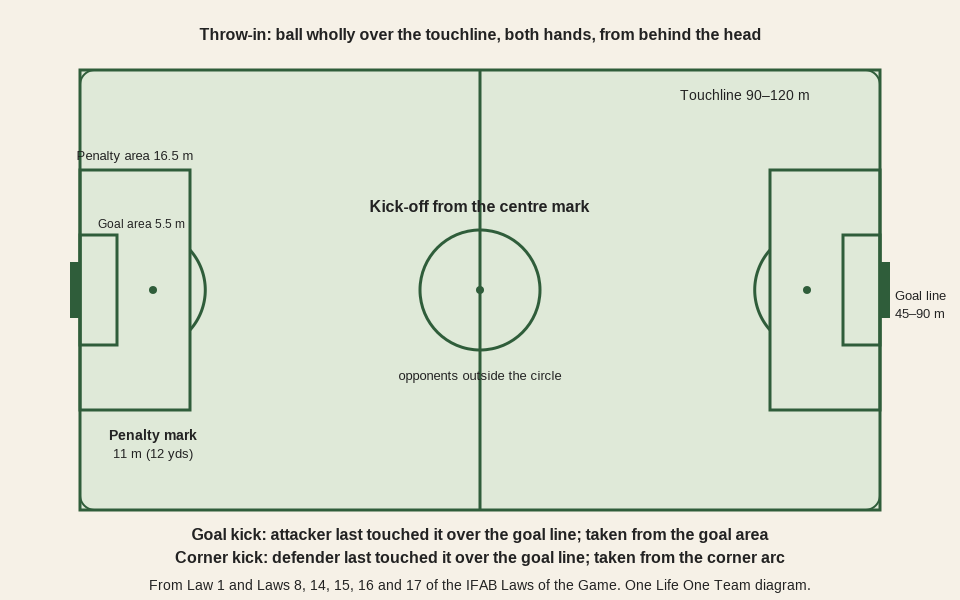
There is no offside offence when a player receives the ball directly from a goal kick, a throw-in or a corner kick. Free kicks and dropped balls are not exempt, which is why defences step up together just before a free kick. A defender who leaves the pitch without permission still counts as standing on the goal line until the next stoppage, so stepping off cannot play an attacker onside. Our complete guide to the rules covers the restarts these cases depend on.
Why the rule exists, and how it changed the game
Without offside, attackers could wait beside the goal for a long ball, and the game would be a series of hopeful punts. The rule forces teams to build play, rewards a well-timed run and lets a defence squeeze the space by moving up as one.
The first FA laws of 1863 were strict: any player nearer the opponents' goal than the ball was out of play, much as in rugby today. The 1866 revision added the three-player rule, onside if three opponents were between the player and the goal; from 1907 a player could no longer be offside in their own half. The great change came in 1925, when three opponents became two. Football League games produced 4,700 goals in 1924–25 and 6,373 in 1925–26 from the same number of matches, and the WM formation grew out of the new defensive problem (see our guide to formations). In 1990 the IFAB ruled that a player level with the second-last defender is onside, where before they had been offside; a 2005 clarification fixed which parts of the body count.
Beating the trap
Attackers have spent a century learning to live with the rule. The skill is timing: a striker who starts a run a fraction after the pass is played can be yards past the defence when the ball arrives, legally. Defences use the rule too, stepping forward together to leave attackers stranded; one defender who fails to move plays everyone onside, and the 1990 change tilted the odds towards the attacker.
VAR, the delayed flag and semi-automated offside
Where video assistant referees are used, the IFAB's VAR protocol lists goal or no goal among the four things the VAR may check, and an offside in the build-up to a goal is part of that check. The protocol also explains the late flag: delaying it is allowed only in a very clear attacking situation, when a player is about to score or has a clear run towards the penalty area, and if the attack ends in a goal, a penalty, a free kick, a corner or a throw-in the assistant must then raise it. A wrongly cancelled attack cannot be restored, but a wrongly allowed goal can be reviewed. The referee makes the final decision; the VAR only recommends a review, and only for a clear and obvious error. Our page on how VAR works goes through the procedure.
Since the mid-2020s the top competitions have added semi-automated offside technology: multiple high-speed cameras fix every player's position at the moment the ball is kicked and produce the 3D replay the officials see. Decisions are quicker and more consistent, though the margins can be a toe. It sits alongside goal-line technology, which answers a different question.
Onside or offside? The common cases
The situations that come up every weekend, with the law's answer.
| Situation | Decision | Why |
|---|---|---|
| Level with the second-last defender when the ball is played | Onside | Law 11.1: level is not an offside position |
| In an offside position, but receives the ball straight from a throw-in | No offence | Law 11.3: throw-in, goal kick and corner are exempt |
| In an offside position, does not touch the ball or block anyone as a team-mate scores | No offence | Not involved in active play |
| In an offside position, scores from a rebound off the post | Offside | Gaining an advantage from a rebound |
| In an offside position, receives a deliberate back-pass from a defender | No offence | The opponent deliberately played the ball |
| In an offside position, pounces after a goalkeeper's save | Offside | A save does not reset the position |
| Standing in their own half when the pass is played | Onside | Nobody is offside in their own half |
Try Freeze Frame
You are the matchday photographer. Five moments, one shutter press each: the save, the header, the ball on the line, the overhead kick and the terrace. How perfectly timed are you?
Sources and further reading
Pages we opened when writing this article, last checked 11 November 2026. They open in a new tab, and we are not responsible for what other sites publish.
- IFAB Laws of the Game 2026/27, Law 11: Offside — Offside position (head, body, feet; arms excluded; level is onside), the three ways of being involved in active play, deliberate play and saves, the three restarts with no offside, the indirect free kick, players off the pitch.
- IFAB Laws of the Game 2026/27: Video assistant referee (VAR) protocol — What the VAR may check (goal/no goal among them), clear and obvious error, the referee decides, and the delayed flag only in a very clear attacking situation.
- Offside (association football), Wikipedia: history section — The strict 1863 law, the three-player rule of 1866, own half exempt from 1907, the two-player rule of 1925 and the jump from 4,700 to 6,373 Football League goals, level onside from 1990, the 2005 clarification, semi-automated offside in the mid-2020s.
This article was written with the help of AI. Before publication, automated checks confirmed that every listed source was opened and every picture is credited. Spotted a mistake? Write to [email protected].
More articles
Football Rules Explained: The 17 Laws, Read from the Book
Football rules explained from the IFAB Laws of the Game: how you win, the pitch and players, restarts, fouls and cards, offside, penalties and VAR.

VAR Football Explained: How Video Review Works
VAR football explained: a video team checks goals, penalties, direct red cards and mistaken identity, but cannot overturn yellow cards or most fouls.

Goal-Line Technology: How Cameras Decide Goals
How goal-line technology tracks the ball, why it only answers one question, and what the rules require before a goal is confirmed.