
Providence Park Portland Timbers vs Columbus Crew 2016-03-05 by Tech. Sgt. John Hughel, 142nd Fighter Wing Public Affairs, Public domain, via Wikimedia Commons
Football or Soccer? A UK–US Glossary of the Game
Two fans can watch the same match and describe it in different languages. One saw a nil-nil draw on a heavy pitch, a booking for the keeper and ten minutes of injury time. The other saw a scoreless tie on a wet field, a yellow for the goalie and ten minutes of stoppage time. Same game, same ninety minutes, two vocabularies, and underneath both a third one: the words the Laws of the Game use, which are often neither.
This glossary puts the three side by side. The table gives the British word, the American word and what it means; the sections around it explain where 'soccer' came from, which words the IFAB defines officially, and the few that mean different things on each side of the Atlantic. Where we have an explainer, such as the complete guide to the rules or the offside rule, this page is the dictionary and that page is the grammar.
Where 'soccer' comes from
'Soccer' is an English word, and an old one. It is Oxford University slang of the 1880s, made the way students then made most of their slang: take a word, cut it short, add '-er'. Association football became 'Assoc.' and then 'socker' or 'soccer'; rugby football became 'rugger' by the same route. The earliest print use found so far is from 1885, in a school journal reporting that Oxford had lost to Aston Villa in 'the most important "Socker" game played in Oxford this term'.
The word travelled. In Britain the game played under the Football Association's rules is simply football; in the United States, Canada, Australia and New Zealand 'soccer' tells it apart from the local football, and Ireland uses both. Major League Soccer, founded in 1996 after the USA hosted the 1994 World Cup, kept the word in its name, and the United Soccer League's plan to bring promotion and relegation to America uses it throughout. Nobody in America invented the word. They kept it when the English let it go.
The table: UK word, US word, what it means
Thirty-four pairs, in the order a match produces them: the game, the ground, the kit, the people, the score, the clock. The meaning column is the plain one; the next section gives the Laws' own wording where there is one.
| UK | US | What it means |
|---|---|---|
| Football | Soccer | The game. The Laws say football; FIFA's name has both words |
| Match | Game | One fixture of two 45-minute halves. MLS's own site says 'match' |
| Pitch | Field | The playing surface; the Laws say 'field of play' |
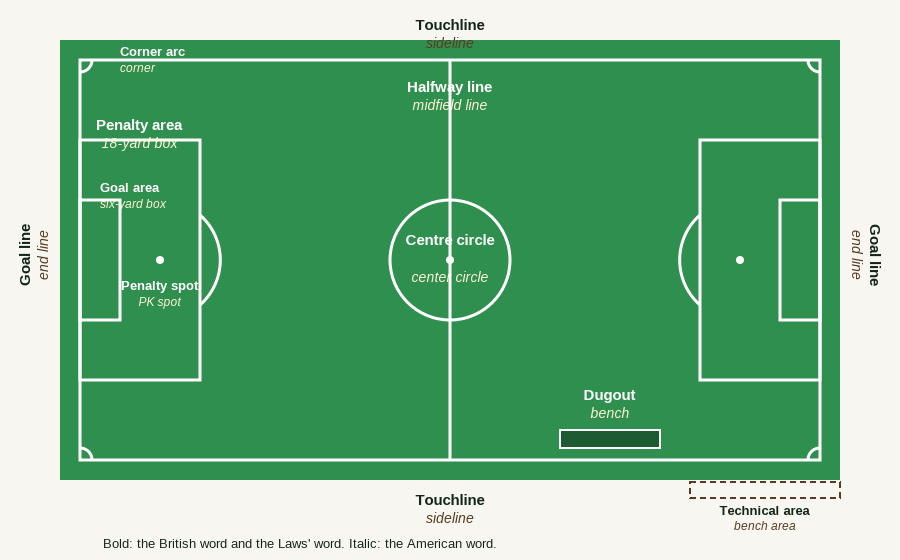
| Touchline | Sideline | The long boundary; over it means a throw-in |
| Goal line | End line | The short boundary; over it means a goal kick, a corner or a goal |
| Halfway line | Midfield line | Divides the pitch; kick-off happens on it |
| Penalty area | 18-yard box | The big rectangle; a foul there by the defence is a penalty |
| Goal area | Six-yard box | The small rectangle; goal kicks are taken from inside it |
| Penalty spot | PK spot | The mark 11 m (12 yds) from the goal line |
| Kit, strip | Uniform | Shirt, shorts, socks, shinguards and footwear, the Laws' list |
| Boots | Cleats | Football footwear |
| Shirt | Jersey | The top; the goalkeeper's must be a different colour |
| Ground | Stadium | Where the club plays |
| Supporters | Fans | The people in the stands |
| Away end | Visiting section | Where the travelling supporters are |
| Terrace | Standing section | A standing area; rare in Britain since the 1990s |
| Manager | Head coach | The person who picks the team; MLS rosters list a head coach |
| Squad | Roster | The club's list of players |
| Dugout | Bench | Where the substitutes and staff sit |
| Keeper | Goalie | The goalkeeper, the one player who may handle the ball, inside their own penalty area |
The words the Laws use, and neither side does
The IFAB, which writes the Laws of the Game, keeps a glossary of its own, and it sides with nobody. The playing surface is the 'field of play', with 'pitch' in brackets. The minutes added at the end of a half are 'additional time', allowed 'for time lost because of substitutions, injuries, disciplinary action, goal celebrations etc.'; neither injury time nor stoppage time appears. A yellow card is a 'caution', a red card a 'sending-off', and deciding a drawn tie by alternate kicks is 'penalties (penalty shoot-out)', renamed from 'kicks from the penalty mark'. 'Extra time' is official: two equal periods not exceeding 15 minutes each.
Three more are worth knowing because commentators use them loosely. 'Advantage' is the referee letting play continue after an offence because stopping it would help the offending team. 'Dissent' is public disagreement with a match official, punishable by a caution. 'Simulation' is creating a false impression that something has happened; the stands call it diving. The whole list is on the IFAB's site, free.
Same word, different thing
A few words are shared and still cause trouble. A 'tie' in Britain is a match in a knockout competition, a cup tie or a two-legged tie; in America it is a draw. 'Table' is the standings in Britain and furniture in America. A 'pitch' in American sport is something a baseball player throws. 'Overtime' in the US covers extra time and, loosely, stoppage time, which is why 'they scored in overtime' can mean two different minutes. And 'terrace' means a standing area to an English fan of a certain age, as our history of the terraces explains, and a patio to everyone else.
One word is a false friend in the other direction. 'Soccer' sounds American to British ears and Oxford to historians, so a British fan who objects to it is objecting to Oxford.
The pitch with both sets of names
The diagram after the table labels the markings twice. The Laws fix what they are, not what fans call them: the touchline must be longer than the goal line, a pitch is 90 to 120 m long and 45 to 90 m wide, no line may be wider than 12 cm, and the penalty mark is measured to the back edge of the goal line. The technical area and the dugout are outside the field of play, which is why a manager who steps onto the pitch is in trouble whichever word they use for it.
Try Freeze Frame
You are the matchday photographer. Five moments, one shutter press each: the save, the header, the ball on the line, the overhead kick and the terrace. How perfectly timed are you?
Sources and further reading
Pages we opened when writing this article, last checked 15 November 2026. They open in a new tab, and we are not responsible for what other sites publish.
- IFAB Laws of the Game 2026/27: glossary of football terms — The official definitions: field of play (pitch), additional time, extra time, caution, sending-off, penalties (penalty shoot-out), advantage, dissent, simulation.
- IFAB Laws of the Game 2026/27, Law 1: The Field of Play — Touchlines and goal lines, dimensions, line width, the penalty mark, the technical area.
- IFAB Laws of the Game 2026/27, Law 3: The Players — Eleven a side, seven minimum, up to five substitutes.
- IFAB Laws of the Game 2026/27, Law 4: The Players' Equipment — The compulsory equipment: shirt, shorts, socks, shinguards, footwear; goalkeepers' colours.
- IFAB Laws of the Game 2026/27, Law 7: The Duration of the Match — Two halves of 45 minutes, a half-time interval of up to 15 minutes, allowance for time lost.
- IFAB Laws of the Game 2026/27, Law 10: Determining the Outcome of a Match — A drawn match; extra time and penalties (penalty shoot-out) as the only permitted deciders.
- Word Histories: the history of the word 'soccer' — Assoc. plus -er, Oxford slang of the 1880s, 'rugger' by the same route, the 1885 'Socker' citation, where football and soccer are used today.
- MLSsoccer.com: About Major League Soccer — Founded in 1996 after the USA hosted the 1994 World Cup; the league's own vocabulary (match, roster, head coach).
- United Soccer League: Promotion & Relegation — The USL's explainer of its promotion and relegation plan, written in American football English.
This article was written with the help of AI. Before publication, automated checks confirmed that every listed source was opened and every picture is credited. Spotted a mistake? Write to [email protected].
More articles
Football Rules Explained: The 17 Laws, Read from the Book
Football rules explained from the IFAB Laws of the Game: how you win, the pitch and players, restarts, fouls and cards, offside, penalties and VAR.
The Offside Rule Explained, from Law 11 Itself
The offside rule explained from Law 11: offside position, the three questions that make it an offence, the exceptions, the history and what VAR does.

What Were Football Terraces and Why Were They Removed?
How football terraces worked, the disasters that exposed their risks, and why the Taylor Report after Hillsborough led to their removal.